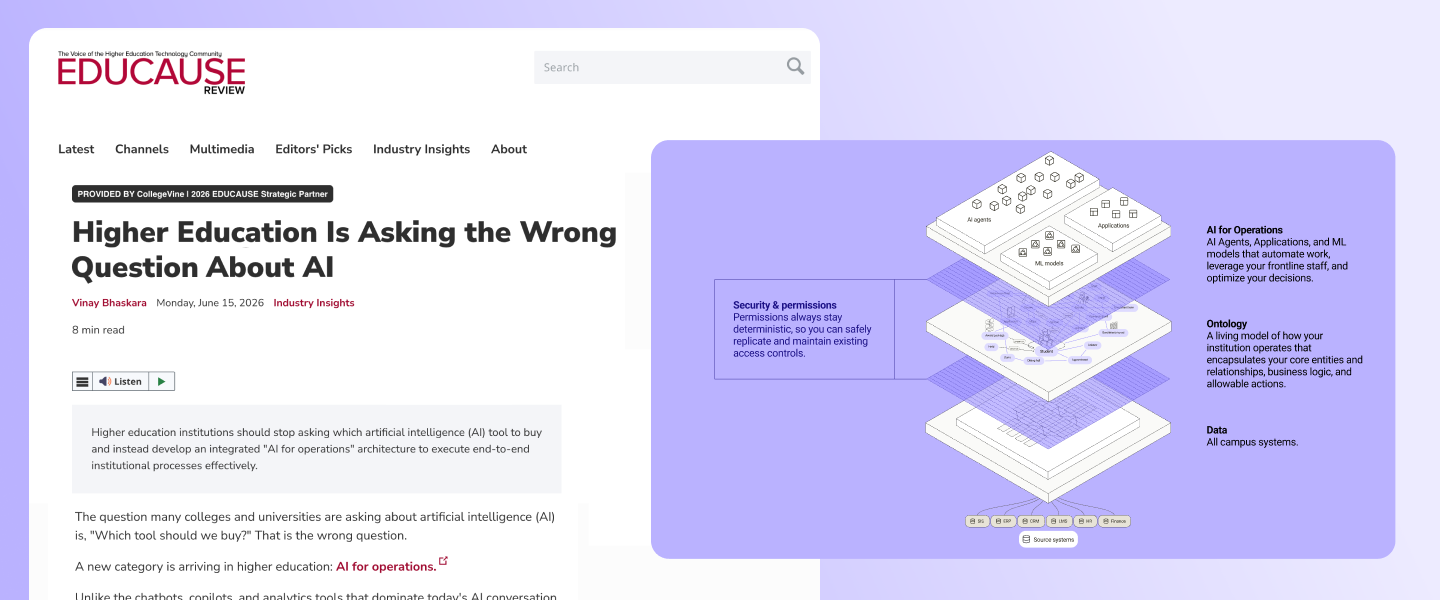

Colleges are already using AI across most of the admissions process: answering applicant questions at any hour, personalizing recruitment outreach, and pulling structured data out of transcripts that arrive in thousands of formats. The decisions themselves still belong to people. That was the consistent finding of Town & Country's August 2026 report on AI in admissions, which spoke with admissions experts and the companies building these tools, including CollegeVine.
For enrollment leaders, the more useful question is not whether AI belongs in admissions. It's already there. The question is where it's earning its keep today, and where it's headed next.
How are colleges using AI in admissions?
The reporting grouped current adoption into three areas: communication and counseling, recruitment and yield, and application processing and evaluation. Across all three, the pattern is the same. Admissions offices are handing AI the important but monotonous work that consumes staff time without requiring human judgment.
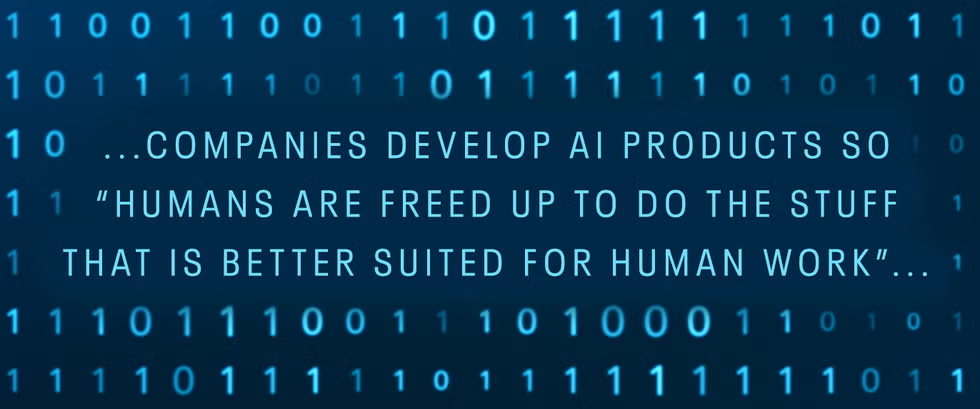
The driver is capacity. "Colleges are being asked to do a lot more with fewer resources," CollegeVine's Emily Smith told Town & Country. AI agents take on the repetitive volume so that, as she put it, "humans are freed up to do the stuff that is better suited for human work," like reading personal essays and making the final call on who to admit.
The volume problem is real and growing:
The numbers behind the pressure. In 2024, the Common Application processed more than 10 million applications, over twice its 2017 total. Northeastern and NYU each received more than 100,000 applications this past cycle. Roughly 2.5 million freshmen start college every year, and another million students transfer. (Town & Country, August 2026.)
Application volume has more than doubled while admissions staffing and budgets have not. That gap is what AI is being hired to close.
Communications: where most colleges start
Communication is usually the first place an admissions office puts AI to work, and it's where applicants are most likely to encounter it. A chatbot for colleges that answers website questions is now common, and AI-drafted personalized email and text outreach is close behind.
Voice is the newer frontier. CollegeVine's AI agents can answer calls from students around the clock and call applicants back when they reach out. The Town & Country reporter, James S. Murphy, experienced this firsthand: an agent named Maple called him, and he described her as sounding like a young woman who was "chill and ready to help."
Around-the-clock availability matters more than it might seem. Smith shared that some students feel more comfortable raising sensitive issues with an AI agent, like a bad grade in a chemistry class, than they do discussing the same thing with their own school counselor. For students at high schools where counselors carry caseloads in the hundreds, an agent that can help build a college list or explain financial aid may be the most responsive guidance available. The Common Application is moving the same direction, recently announcing a partnership to integrate an AI advisor into its platform.
How does AI change recruitment and yield?
Traditional student recruitment runs on volume. A regional private college enrolling 500 freshmen may license hundreds of thousands of student names, then send the same emails to all of them on a preset schedule. Most of that outreach lands on students who were never a fit.
AI changes the economics in two ways. First, it analyzes the recruitment funnel as it happens, tracking which students are opening emails, visiting program pages, and registering for events. Second, it acts on that analysis. Smith explained that AI recruiting software improves on the "stale, generalized content" colleges typically send by using a range of data on each student to craft individualized messages. Instead of a mass email, a student gets a text at the time of day they usually respond, about the chemistry program whose page they've been reading.
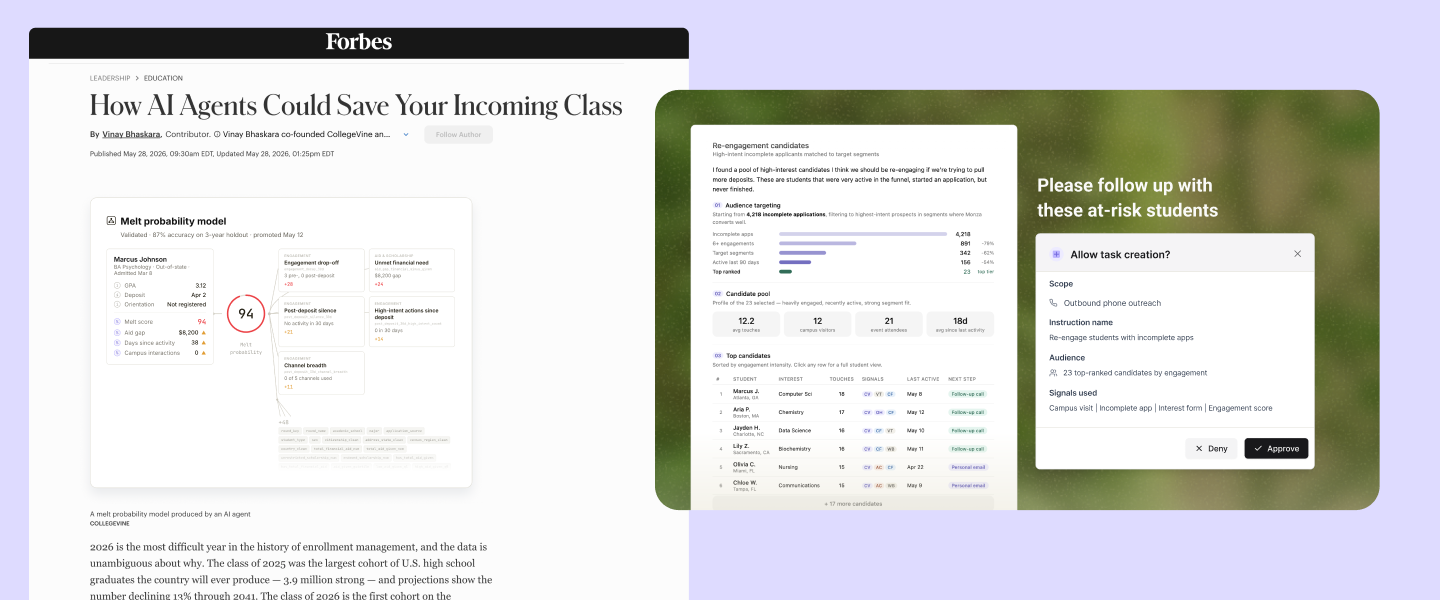
The same approach extends past the admit letter. AI agents can nudge admitted students through deposits, paperwork, and financial aid steps, which is where yield strategies usually leak. It also ends a familiar failure mode: the panicked form email pressuring a student to submit paperwork they already submitted. See how Rensselaer Polytechnic Institute uses a financial aid agent to power a deposit and melt tracker its enrollment team runs, and why AI agents may be the most direct way to protect your incoming class.
What does AI mean for demonstrated interest and privacy?
Colleges have tracked demonstrated interest for years through website visits, email opens, and event signups. AI raises the stakes because it makes broader tracking cheap. Researchers interviewed by Town & Country noted that buying and integrating a student's search history remains too costly and complex for most institutions, but using an agent to scan an applicant's public social media for signals of interest in a school is now simple enough that some institutions are likely already doing it.
That is a policy question as much as a technical one, and institutions are better off answering it before the tools outrun their governance. Admissions offices adopting AI should be able to say what data their agents touch, what they do with it, and what they will not do. Our guide to the three questions to ask before deploying an AI agent is a starting point.
Is AI making admissions decisions?
No. Every company and expert in the Town & Country report said the same thing: humans make the admit decision, and none of the vendors expect that to change. The article's opening line puts it plainly: "Artificial intelligence is not deciding who gets into college."
What AI does do in evaluation is preparation. Transcripts are the clearest example. There are nearly as many transcript formats as there are high schools, and readers burn hours just figuring out what they're looking at before they can evaluate it. AI can extract courses and grades, then add context, like flagging that a student's two AP courses were the maximum their school offered. Molloy University's operations team got 835 hours back by processing transcripts this way. Similar tools summarize files and triage which applications a human should read first, which speeds the work without replacing the judgment.
Transparency is the watch item. The experts interviewed drew a consistent line: colleges don't owe applicants disclosure about document processing, but if AI ever starts influencing decisions, students need to be told.
What should enrollment leaders take from this?
The Town & Country report describes an industry being deliberately conservative, using AI where the work is monotonous and the payoff is immediate, and keeping people on the judgment calls. That's the right order of operations. The offices getting value today started with a contained, high-volume problem, proved the time savings, and expanded from there.
For the broader landscape of where AI is working in higher ed operations, from transcript processing to fraud detection, see our guide to the 6 AI use cases gaining traction in higher ed operations. And if you want to see what an admissions AI agent sounds like on a real call, get a demo.
FAQ
Is AI deciding who gets into college? No. Reporting across the industry, including Town & Country's August 2026 investigation, found that admission decisions are made by human readers and committees. AI handles surrounding work like communications, document processing, and file preparation.
How do admissions offices use AI chatbots and voice agents? They answer applicant questions on websites, by text, and by phone at any hour, including questions students hesitate to ask a counselor. More advanced agents can also place outbound calls to applicants who reached out.
Can colleges use AI to track demonstrated interest? Yes, and many already track engagement like email opens and site visits. AI makes broader tracking cheaper, including scanning public social media, which is why institutions should set clear data policies before deploying it.
Will AI replace admissions readers? Current adoption points the other way. AI is taking over transcript extraction, summaries, and triage so readers spend their time on essays, context, and decisions. Vendors and admissions experts agree the final decision stays human.







.png)
.png)


.png)